Thursday, 29 September 2016

Can Animals Predict Earthquakes?
☯
By:David.B & Amanda.P & Brooke.C

All humans and animals detect S waves from an earthquake,but animals can detect smaller P waves that travel faster than the S waves. We have also discovered that animals also detect an earthquake weeks or seconds before it happens.
Our group has decided to go further with this discovery about animal predictions of earthquakes.

http://s3.crackedcdn.com/phpimages/article/3/2/4/16324.jpg?v=1
Humans cannot detect the smaller P waves admitted from earthquakes but most animals can detect the P waves. Since P waves travel much faster than the more destructive and slower S waves, animals can detect  and leave their their home and go to safety before the S waves come.

Rats, weasels, snakes and centipedes have left their homes and seeked shelter somewhere else several days before the destructive Earthquake. Catfish moving violently, chickens that stopped laying eggs and bees leaving their hive in a hurry have been reported.


Scientists had no clue why and how they were detecting earthquakes several days before it happened but now they know how. Scientists detected disturbances in ionosphere in the earth’s atmosphere which contain high amounts of concentration of ions and free electrons and is able to reflect radio waves which started two weeks before the earthquake.

Positive airborne ions, which are known to be generated in large numbers at the Earth’s surface when rocks deep below are subjected to increasing stresses during the build-up to an Earthquake. Positive ions in the air lead to unpleasant side effects in animals and humans, such as serotonin syndrome.


https://upload.wikimedia.org/wikipedia/commons/2/24/Serotonin-Spartan-HF-based-on-xtal-3D-balls-web.png

This is caused by an increase in serotonin levels in the bloodstream, and can lead to symptoms such as restlessness, agitation, hyperactivity and confusion. They expected the injection of positive airborne ions into the Earth’s atmosphere before seismic activity to have a heavy effect on mammals and birds, In particular those living on the ground and in burrows


How big are Earthquakes?
By: Andrew, Mitch, and Ryan

Earthquakes are a part of our world. They happen every year and can cause great damage. But how big is the average earthquake?

Well, on average there are about 1500 earthquakes happening each year since 1990. Most of these earthquakes measure between 5.0 and 7.9. There are said to be millions of earthquakes happening all over the world each year but the happen in remote areas, or do not reach 5.0 on the richer scale.
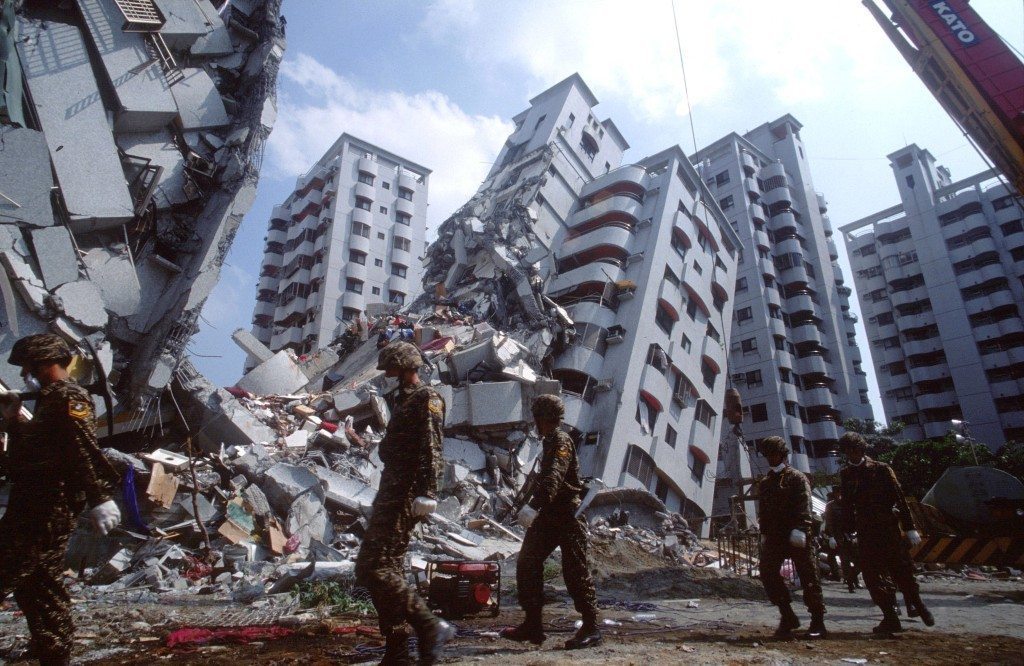
Image result for 1998 earthquake
Earthquake occurring in a densely populated area.

That being said the most common earthquakes that occur each year reach a magnitude of 5.0 to 5.9. An earthquake of this size, can be felt shaking, but is not powerful enough to cause major damage to buildings, landforms, and structures.

Earthquakes can happen anywhere anytime, and are caused by the friction of tectonic plates colliding. There are many different kinds of earthquakes, and these are determined by how the plates collide with each other. If one of the plates slips below the other it is called a normal fault. If a plate pushes above the other it is called a reverse fault. Finally, if two plates rub against each other sideways, it is called a strike slip.
Image result for strike slip fault
Diagram of a strike slip fault. During the earthquake, the ground slides as the plates moves past each other.

The type of fault that causes the most damage is the strike slip fault. These faults are known to be able to cause size 8.0 earthquakes. Strike slip faults are found all over the world and some of the most famous faults are strike slip. The San Andreas fault found on the west coast of North America is a strike slip fault. Other well known strike slip faults include the alpine fault, the Denali fault, and the great glen fault.


Photos from:

Wednesday, 28 September 2016

What To Do During An Earthquake!
By: Chloe

Last week our geography class watched a video about earthquakes. After watching this video it left us questioning many things. One particular question that had left me puzzled was “what do you do during an earthquake?” So after a little bit of research I have compiled a list from a bunch of different resources.

Before an earthquake make sure to have a battery operated flashlight, first aid kit, fire extinguisher and extra batteries. You also should learn to shut off the main gas, electricity and water. Secure all heavy objects or anything that might topple over. Following these steps will assure better results.

During an earthquake drop, cover and hold on. Remember to stay calm and stay put! Most injuries occur from trying to leave a building or moving to another room. Drop to the ground, take cover by getting under a sturdy object and hold on until the shaking stops. If there is no sturdy object near you cover your face and head with your arms and crouch down by a corner of the building. Cover your head and neck until the shaking stops. These few steps will help ensure your safety.
http://www.larchmontbuzz.com/wp-content/uploads/2012/10/shakeout2.jpg
If you are outdoors during an earthquake stay outdoors do not try to get back into the building, instead go into an open area away from the buildings so that flying debris won’t  injure you. If you happen to be in a crowded place take cover somewhere you won’t get trampled on by people running.

Things to avoid during an earthquake are doorways because they most likely will fall down, windows, bookcases, tall furniture, light fixtures, elevators and downed power lines.

After the earthquake make sure to check your home for structural  damage and stay away from chimneys and bricks in case they are broken. Do not light matches or turn on any lights.


Photos from: http://answersafrica.com/wp-content/uploads/2015/05/Earthquake-e1431700006526.jpg
http://www.hindustantimes.com/Images/popup/2015/4/nepalquake12.jpg
Will We Ever Be Able To Predict Earthquakes?
Blog by:Ben,Brayden and Markus


  Scientists have tried many different things to predict earthquakes but none of have been successful so far. They have a pretty good idea of when they will hit but they still don’t have a geat idea of when it’ll happen.

  However the probability of a future earthquake happening can be calculated, based 0n the data that scientist have collected, they predicted that 30yrs frm now San Francisco will have a major earthquake, about 67% sure that it will be likely to happen.

  We have found that we can test for vibration underneath the earth’s surface and find it but only moments before and earthquake will actually happen, not giving us enough time to escape, scientist have been drilling down about 800ft to test the vibration of the ground, that way they can somewhat predict if one will happen they just don’t know when it will happen or how big it will be.

photo from www.everythingselectric.com
Here are some different ways scientist predict earthquakes


Earthquakes Prediction methods
-unusual animal behavior
-water level in wells
-seismic electric signals
-radon emission
-foreshocks or minor shocks before a major earthquake
-statistical probability
-putting lazzers across a fault to detect any small movements
-monitoring water levels


  It’s very unlikely that they will ever be able to predict them, we have tried multiple ways but none have been successful scientists used to think we were getting close to being able to predict exactly when a quake will happen but they now know it will be a long time until we will know when they will happen.

What is the Richter scale and how does it work?
Blogged by:Collier

The Richter scale was developed in 1935 by Charles F. Richter of the California Institute of Technology as a mathematical device to compare the size of earthquakes. The magnitude of an earthquake is determined from the logarithm of the amplitude of waves recorded by seismographs.

https://upload.wikimedia.org/wikipedia/commons/0/08/Earthquake_Richter_Scale.jpg
For an example the earth quake in Haiti in 2010 was a 7.0 magnitude earthquake
http://inapcache.boston.com/universal/site_graphics/blogs/bigpicture/haiti_01_13/h38_21698163.jpg
I found this inquiry very fun to do and learn how about how they actually measure the size of earthquakes.
DID YOU EVER THINK THERE WERE ADVANTAGES TO BUILDING YOUR HOME ON A FAULT LINE?
Blogged by: Cole, Nicholas, Jess
    A lot of people researching earthquakes and fault lines ask the question, “why do people continue to build their homes near fault lines?” They don't see the advantages that the fault lines create. For example the soil near fault lines is very fertile from the years of molten rock, magma, and ash. This makes the soil very easy to farm, maintaining less expensive life.
www.alarabiya.net
Other advantages of living on fault lines are that the land may be cheaper because you are endangering yourself and others by living there. For hundreds of years families have built on fire, hurricane, and tsunami active land so why does building on a fault line make it such a big deal!?
Some of the disadvantages of living on a fault lines are:
There are many disadvantages of living on a fault line including. It is very dangerous for yourself and others living with you. Any earthquakes that occur will impact your home with full force, damaging your home over time. This cracks the foundation and makes your home an unsafe place to live. Magma may also erupt from the earth’s surface burning anything nearby. It ruins homes and crops, it takes many years to rebuild.

After reading advantages and disadvantages of living on a fault line, where would you prefer to live?
The QUAKES
Blogged by: Maya
As a grade 9 student in geography i have decided to explore the topic of fault lines and why people build cities over/by them as well as why people decide to move their

Fault lines:

If you are wondering what a fault line is, it’s a rock surface or ground that traces the geological “border” there are many fault lines around the earth , some of the infamous ones are
  • The ring of fire
http://static1.businessinsider.com/image/55a811772acae72d5f8b6c88-1297-783/screen%20shot%202015-07-16%20at%204.13.10%20pm.png
  • The san andreas fault


And many more.
    Fault lines tend to be the earthquake danger zone because that's where the quakes originate.

Why do people build cities on fault lines ?

A lot of  the time the fault lines are:
- fertile
- have lots of natural resources  such as:
    -fossil fuels
    -ore deposits
- for the people that live their,Great weather
I also believe that when the city or town was first being built that the “owner” did not know what a fault line is or did not know that one was there, and because the land was so fertile it was a good spot to start a population.


Why don't they move from the city, or the city itself ?

    People in the city normally think that the quake won't happen in their time, so they are not that worried. As i read through comments on several sites, people say that quakes are not such a big deal, compared to serial killers, traffic accidents ...etc…
    The government doesn't move the cities on the fault lines because it costs less to fix the initial damage of the quake than to move the city to a new location.
    
    I found this topic on, why people build cities on fault lines interesting and hope you do to, and that you find what you are looking for, whatever it may be.
Thank you for reading!